| |
Environmental
Studies
One of the test trenches excavated across a street in 2004, TT 24, was
partially reopened and extended in order to experiment with ways of recovering
environmental evidence. In 2004 it was found that considerable amounts
of (domestic) rubbish, containing animal bones and charred plant remains
had been dumped on the street surface.
The animal bone is generally in poor condition which, combined with the
hardness of the soil when dry, made recovery of easily measurable fragments
both difficult and timeconsuming. It was concluded that wetting the soil
before excavation makes bone extraction easier with very significantly
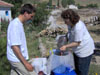
less breakage. Experiments with simple floatation, using a series of buckets,
produced seeds and charcoal whilst wet sieving the residue permitted the
extraction of small bones and bone fragments.
The material recovered is now being studied at METU by Dr. Vicky Ioannidou.
Excavation across streets in future seasons will have the recovery of
similar environmental material built into the research design.
Anatolian Iron Age Pottery Project
Professors Lisa Kealhofer and Peter Grave took more than 100 samples from
Iron Age pottery sherds for destructive analysis in Australia. This was
done as part of a five-year study of Iron Age Pottery from Central and
Western Turkey.
Dendrochronology
Many samples of charred wood from the Monumental Entrance were wrapped
for export to Cornell University where they will be studied by Prof. Peter
Kuniholm and his team. Most of the pieces are, however, quite small and
it may well turn out that few if any have a sufficient number of preserved
rings to be of use.
|
|