| |
Architectural Sandstone Elements from Tower Corners
A number of large carved sandstone elements were recovered amongst the
collapse that most probably fell from the northeast corner of the South
Tower. It can now be understood that the southeast corner of the North
Tower must have been provided with matching elements of which few fragments
survived. While it is clear that the general scheme included bolsters
and bolster like elements, more work is needed to reassemble broken fragments
before a convincing reconstruction of the architectural scheme can be
finalised. Some of these blocks bear “masons marks” that resemble (single)
Old Phrygian letters. A large block (ID 05TR17U12arc11) has a raised edge
band and a circular feature at the end of a diagonal band (Fig. 47)
which is thought to indicate the angle at which a roof or pediment was
pitched.
Possible Sandstone Capitals
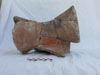
Large sandstone bolsters (e.g. Fig. 48
for bolster ID 05TR17U12arc07), all fragmentary, very probably broke off
from the edges of sandstone capitals to the freestanding wooden columns
at either end of the entrance. The estimated number of these bolsters
is not inconsistent with a total of four such capitals each having a pair
of bolsters or, just possibly, four bolsters on each. Joining of the many
fragments is still in progress and it is hoped that it will prove possible
to restore completely the precise form and size of these capitals, if
such they are, at least on paper.
Sandstone Bolsters
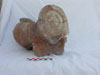
Sandstone bolsters (e.g. Fig. 49a-49b
for bolster ID 05TR16U14arc04), in addition to those mentioned above,
were found in a variety of sizes. It would seem that some of these and
very possibly all except the small examples that belong to a square element
from a freestanding monument illustrated in previous reports, appear to
have come from the walls of the towers.
One bolster (not illustrated), found in a much abraded condition on the
pavement west of the entranceway, came possibly from another building,
perhaps the Audience Hall from whence it would have rolled down.
The Statue
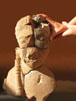
More joining fragments of the draped figure in human form (K04.182 with
ID 04TR16U02stn01 and several joining fragments) were found and it can
be reported that the context is better understood. Additional fragments
of the ribbed skirt were recovered from a robber’s pit, but of the feet,
presumably carved on a base block, no trace has been found.
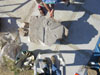
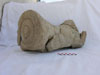
More positively, the left eye (Fig. 50),
together with other poorly preserved fragments from the head (ID 05TR17U14stn01),
were found laying directly on the stone pavement below the remains of
burnt thatch probably fallen from the tower roof. This context makes it
certain that statue was smashed in the entrance passage before the fire,
increasing the likelihood that it originally stood no great distance from
where it was found. More negatively, neither the left arm, which seems
to have been somehow extended away from the body, nor the top of whatever
was held over the right shoulder have been found. Thus neither the gender
nor the identification have been ascertained. In another development,
it is now thought that the small steeply inclined hole in the side was
probably intended to affix the figure to the large squared wooden dowel
that was inserted into the lower quarter of the statue. One suggestion
is that lead was used for this purpose, pieces of molten lead having been
found in the destruction debris; but if so not a trace now remains. It
is possible that further joins will be made, but unlikely that they will
add to our understanding of this enigmatic and forceful portrayal.
Sculpted and Inscribed Stone
Study of the freestanding block bearing panels of small-scale relief sculpture
with Old Phrygian inscriptions on some of the raised borders (Fig. 51)
continued during the summer. New joins between previously excavated fragments
have permitted a much better understanding of the original scheme. It
is now known that the block (K03.168 with ID 03TR11U08stn02 and several
joining fragments) was rectangular in profile and probably square in plan.
The main panel on the front seems to have depicted two clothed figures
facing one another beneath a winged sun-disc. It is probably that these
figures were griffin-headed genii. The inscription runs around the four
raised borders of the front. A shorter inscription on the left side of
the block (when viewed from the front) names the dedicant, Tata. Lions
seem to have adorned the side panels and somewhere there was vegetation.
It is not clear if the back side of the block was also sculpted. We look
forward to Professor Claude Brixhe’s study of the text with bated breath.
The sandstone block from which these fragments of inscription and relief
had sheered off has not been found and, to compound matters, there are
some fragments so distorted and vitrified by the fire that, although they
appear as though they may have been part of the piece, no form or inscription
can be discerned. Further, a small number of sculpted relief fragments
have been recovered that may or may not belong; but these are insufficient
in number and size to permit even the most tentative reconstruction.
One fragment of equally small-scale sandstone sculpture, this time in
the round, probably depicts the feet of a bird of prey gripping a bone.
Similar votive statuettes of birds perched on bones, made of alabaster,
are known from sixth century contexts at Gordion.
Decorative Metal
A Decorative Bronze Band
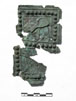
An incomplete length of sheet bronze (K05.204 with ID 05TR17U14met01),
has embossed and stamped decoration in the form of two square panels,
one above the other. The top panel contains a bull while that below has
a griffin, both facing left (Fig. 52).
Added domes border the panels. There are small sewing holes along the
top and right edges.
A Bronze Fitting
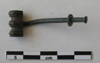
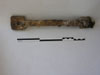
A cast bronze fitting (K05.203 with ID 05TR17U12met01), perhaps from a
bowl, is remarkably well preserved (Fig. 53).
Gold Sculptural Embellishment
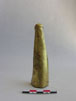
A thick piece of gold sheet (K05.215 with ID 05TR16U16met05) was discovered
on the pavement immediately in front of the southern column base at the
front of the entrance. It was formed round a wooden core to which it was
once attached by a single nail, perhaps in the shape of a horn with a
knobbed end (Fig. 54).
The presence of this precious object might indicate why the later robbing
of the entrance was so extensive.
Iron and Stone Architectural Elements
Iron Bands
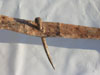
Two large iron bands (K05.191 with ID 05TR16U18met05, K05.192 with ID
05TR16U18met06), almost identical to those discovered in 2002, were found
against the tower wall on the south side of the passage. Fragments of
similar bands were also recovered from the inner end of the entrance,
although these were less well preserved than the complete bands from the
front which are still tensile to this day. Some of the holes punched through
these bands still contained large dome-headed nails (Figs 55
and 56)
while fugitive nails were found in the burnt debris nearby. It is thought
that these derived from the doors, their being two horizontal bands on
each. The dimensions are not inconsistent with this interpretation and
the find spots lend further support the conclusion that the doors had
been taken down before the fire, perhaps to remove metal embellishment
and to loot out metal door sockets.
Iron Braces
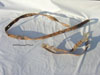
A second large iron brace (K05.207 with ID 05TR17U14met07) found in 2005
near the South Tower is very similar to the one found in 2002 by the North
Tower and amplifies the architectural symmetry of the entrance. The brace
(Fig. 57)
has squared ends and large domeheaded nails.
In addition, a number of smaller braces with splayed ends and smaller
nails paralleled those found in the two previous seasons. Like the bands
described above, these iron braces are witness to the structural importance
of iron in strengthening timber construction.
Ivory Inlay Fragments
Many small semicircular ivory inlays were recovered from the vicinity
of the central screen. There are no indications as to what they were originally
set into, but they seem rather small to have come from the screen itself.
Photographic Recording of Finds from the 2005 and Previous Seasons
High resolution digital photographs were taken of most of the objects
from previous seasons as well as from those found during the early part
of the 2005 season. All other finds were recorded by means of digital
photography, most images being of publication standard. In addition there
are many digital photographs of conservation in progress, particularly
the architectural blocks. Traditional black and white negatives have been
abandoned because of the difficulty of processing and printing, as well
as cost. Colour slides continue to be used for some of the larger objects,
as well as for site photography, but a combination cost and practical
considerations has mean increasing reliance on digital imaging.
|
|