| |
Clearing, Conservation and Enhancement at the Cappadocia Gate
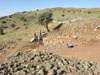
Collapse of the section cut across the passage of the Cappadocia gate
in 2002 as well as erosion that was continuing to undermine the northwest
wall of the passage made it desirable to ramp down the passage fill (Fig.
44). This
course of action not only made the entire gate visually more attractive
but it also enabled measures to be taken that route human and animal traffic
through the original passage rather than by the modern track that traversed
the southwest tower. Visual enhancement was further improved by revealing
the topmost surviving part of the glacis in front of the southwest tower
which had been covered by the track. The original passage surface, which
still retains fragile traces of the fire which brought the life of the
city to a close, has now been preserved beneath a layer of rubble which
has also covered the base of the passage walls. At the same time the uppermost
intact courses of the passage walling have been, for the first time, exposed
over their entire length.
One important result of this work has been to establish that the passage
was not restricted by buttresses or architraves. Thus there is no indication
as to precisely where the wooden doors were hung, although it hard to
imagine that the six metre wide passage was not closed by one, if not
two, sets of double doors. The inner gate passage, between the inner towers
is wider than the outer passage, making it a less plausible option for
either the position of the doors or for an elevated walkway (to take defenders
from one side to the other) which would have been best positioned immediately
behind the doors or between the two pairs of doors if such there were.
Restoration
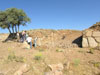
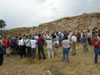
For most visitors, the Cappadocia Gate is one of the highlights of their
visit (Figs 45
and 46).
It has however been decided that no further work can be undertaken at
the Cappadocia Gate until and unless there is a comprehensive program
that would involve the insertion of scaffolding and props followed by
a dismantling and rebuilding of the wall faces of the passageway and the
internal chamber. Such a plan of action would not only require engineering
expertise and very considerable financial resources, but would also require
agreement concerning the ethics and principles of restoration.
|
|