| |
The
Monumental Entrance to the Palace Complex
So as to distinguish
it clearly from the seven city gates in the 7km of defences, the large
and visually impressive public monument, with its two massive towers and
a passageway leading towards the Audience Hall, has been labelled the
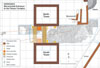
'Monumental Entrance' to the Palace Complex (Figs 19
and 20). The
monumentality is obvious enough. It is undoubtedly an entrance, and thus
a type of gate, so that by definition it demarcated space and controlled
passage between the outside and the inside.
The report that follows represents a culmination of several seasons of
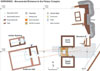
survey, clearance and excavation (Fig. 19).
Work on final detailed plans and architectural elevations is not yet complete.
Many architectural details need to be resolved by further work on the
smashed blocks now in the excavation depot. Nevertheless, the general
scheme and the plan are already clear (Fig. 20).
The entrance passageway, overlooked by two massive towers, is orientated
east-west and the symmetry of the architecture, both in plan and in elevation,
is striking. The large expanses of stone paving, leading to and beyond
the entrance as well as in the passageway itself, surely indicate that
it also served a variety of public functions, formal and informal.
The size, intended to impress and doubtless intimidate, might also reflect
the need, on this high southern ridge at Kerkenes, for cover and shelter
from the natural elements during much of the year. Large and impressive
though it was, it does not seem to have been designed with defence (against
hostile enemies) as the foremost concern. Indeed it can hardly have been
defensible at all whilst the combustible materials from which it was constructed
almost invited burning.
Aims of the 2005 Excavation
at the Palace Complex
Excavation in 2005 was aimed at revealing the entire entrance
passage from the front of the Towers to the central partition (Fig. 21
trenches TR15 to TR19) as well as uncovering part of the inner passageway,
from the front (eastern) façade to the rear (western) façade and, if time
allowed, beyond towards the Audience Hall (Fig. 21
trenches TR14, TR20 and TR21). There were three purposes; firstly to recover
any further fragments of sculpture and inscription that might be in the
disturbed fill of the passage leading to the front façade, secondly to
gain better understanding of the architectural scheme and, thirdly to
enhance the visual appearance of the monument while at the same time making
it less hazardous to visitors. All three of these aims were achieved and
thus the present program of excavation in this Monumental Entrance has
been completed.
Progress and Methods of Work
The loose fill of the entrance comprised, for the most part,
very loose stone rubble and debris with, immediately on the pavement,
ash and patches of charred reed thatch (Fig. 22).
Extensive and irregular robbing, down to and occasionally through the
stone paving, was the cause of the random scattering of carved, sculpted
and inscribed fragments throughout the pit fills. The fill was carefully
sorted and removed by hand. Granite rubble, which made up most of the
fill, was examined and discarded. Burnt and vitrified debris and large,
broken and shattered sandstone blocks were stacked on the site. All other
sandstone was taken to the Excavation Laboratory where it was washed and
sorted. Where necessary sieves were used to extract the sandstone, but
it was not possible to shake a sieve without further breaking the friable
stone, so that material was sorted on perforated plastic screens. Broken
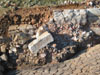
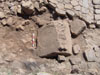
and shattered architectural blocks (Fig. 23),
some with bolsters or bolster-like reliefs, were recorded in situ before
being taken to the laboratory for cleaning and reassembly. These processes
made excavation slow and tedious. The extent of damage caused by large
blocks tumbling from the tower wall onto the pavement combined with the
loss of many architectural fragments as a result of vitrification during
the fire as well as dispersal in later robber pits, hampered recognition,
excavation and conservation.
While it may be said with confidence that nothing of importance was missed,
it is sad to report that the intensity of the fire had so broken the masonry
of the passage walls that very little remains in situ. The horizontal
gap left between courses after the horizontal beam completely burnt down
caused the wall of the Towers to become structurally unstable. Many of
the large stones shattered as the result of the intensity of the fire
had to be removed for safety. As a temporary measure wood was used to
prop up what remains of wall facing, but this has been done for safety
pending implementation of a conservation and restoration program.
Excavation Records
Excavations were documented as in previous seasons with plans, sections
and photographs. An east-west longitudinal section through the centre
of the Monumental Entrance was completed and recorded by making mosaics
of rectified digital photographs at a scale of 1:20, printing the images
and annotating in the field. The faces of the passage walls were dealt
with by the same method whilst other sections, less likely to collapse,
were drawn in the traditional way. Rectified digital photographs were
also used to record the stone pavement and associated features. Digitising
these photographs so as to produce detailed plans and sections is in progress.
The careful recording of features by digital photography will contribute
to the creation of a virtual environment and monument.
The Architecture of the Monumental Entrance
An architectural scheme of remarkable symmetry boasts a monumental entrance
between two massive towers (Fig. 25
and 26).
Nothing can be seen of the internal arrangement and floors of the towers,
the core of each having been extensively dug into by robbers. A large
column base, adjacent to the front end of the tower walls, stands proud
of the sloping pavement on either side of the passage.
The towers are separated by a 10.50m wide stretch of stone pavement leading
to a façade that crosses the passage close to the centre (Figs 27
and 28).
The passageway enters the front façade through a large double doorway
and exits, most probably through a similar doorway, in the rear facade.
The inner passageway was reduced in width by a small room which is presumed
to have been mirrored on the other side. Beyond the rear façade the entrance
opened up onto another stone paved area where a third column base sat,
before it was disturbed by robbers, just outside the backline of the tower
against the end of the rear façade. A small drain set in the paving runs
parallel to the façade preventing water from running down through the
doors into the passageway. A plinth on one side of the front façade and
an anaconic stele standing at the door of the rear façade have, in anticipation,
both been mirrored in the plan (Fig. 27).
The Approach to the Monumental Entrance
The front half of the broad passage, which is inclined at a gradient of
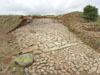
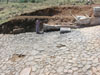
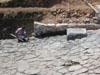
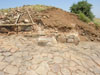
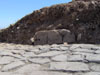
approximately 1 in 5, is paved with granite worn to a polish (Fig. 30).
Setting lines in the portion of pavement in front of the towers are not
parallel to the orientation of the entrance but lead to the doorway of
the Audience Hall (Figs 20
and 27),
demonstrating that the original pavement and the Audience Hall pre-date
the construction of the Monumental Entrance. At the inner front corner
of each tower the top of a foundation stone can be seen slightly above
the level of the top of the pavement and projecting in both directions
for a few centimetres beyond the line of the upper walling. This slightly
wider footing appears, however, to be restricted to the corner stones
and is not observed along the tower walls rising up the passage slope
(Fig. 31).
The square sandstone column bases on either side, set back c.2.05m from
the front of the towers, have shallow circular recesses c.0.85m in diameter.
In all probability these were for tall, freestanding wooden columns provided
with sandstone capitals (although an alternative possibility is discussed
below). These bases were shaped in position, as was the rectangular conglomerate
plinth preserved at the southwest corner of this front portion of the
entrance. The plinth, measures 2.10m by 0.70m and was presumably mirrored
by another one on the opposite side of the door. From the front of the
towers inwards the paving was re-laid up to the walling, column bases
and the, presumably two, plinths. This may be demonstrated by the row
of particularly large stones along the line of the tower fronts.
It is now thought that this front section of the Monumental Entrance was
unroofed for several reasons. Firstly the span, while not impossible,
seems very wide, particularly as there was only a single pair of columns.
Secondly, the steep slope of the pavement would have made roof construction
difficult. Thirdly, if it is correct to reconstruct a large timber façade
founded in the wide slot at the top of the slope any roof would have obscured
it from view. Lastly, it would seem that the distribution of burnt debris,
in as far as it could be ascertained between the robbing pits, is perhaps
more consistent with burning of the façade and double doors than that
of a passage roof. The fragments of burnt roofing, including pieces of
clay with reed and wood impressions as well as deposits of charred reeds
most probably fell into the entrance passage from the towers on either
side.
The Position of Sculpted Monuments
Pieces of sculpture and inscribed monument, described later in this report,
were recovered from the debris from the front portion of the entrance.
These include a statue of a human figure and an inscribed block bearing
small-scale relief sculpture. Other elements, perhaps associated with
one or both of these pieces, are still being reassembled from the fragments
that escaped both fire and later looting. A horn of sheet gold formed
around a wooden core points to the presence of embellished wooden pieces.
It can be noted that there is no indication as to what stood on the stone
plinth (and its presumed twin) in front of the partition. Measurements
and proportions make it rather unlikely that any of the small scale fragments
recovered stood on them. It has however been suggested that the sandstone
column bases did not support tall freestanding (votive) columns of wood
with stone capitals, but that they carried short, columnar, wooden statue
bases.
In any event, there are no reasons to doubt that everything set up within
the entrance was torn down and smashed before the fire.
The Front Façade between the Towers
Approximately half way along the side of the towers, a 2.20m wide slot
appears to be a foundation trench to a structure which has been described
as the front façade (Fig.32).
The burnt and vitrified debris and perhaps some traces of vertical posts
indicate a timber frame structure with infill rubble and mudbrick.
Along the edge of the pavement, in the centre, five large stone pavers
indicated the position of large double doors. Traces of the door posts
could be discerned on either side. It would seem that these doors were
set in a large wooden frame partition. The total width of the five pavers
is c. 4.20m whilst the width of the slot for a façade between the different
elements of the entrance is c. 2.20m, i.e. wide enough to take the width
of each of the inward opening doors. The preserved southern wall of the
passage changes abruptly from impressively large cut blocks to rubble
construction with timber elements, clear evidence that it was hidden from
view by the partition.
An absence of ash and charcoal in the wide foundation slot, which was
filled with masses of fused stone rubble and mud that most probably came
from the upper walling of the towers as well as the core of the façade
itself, suggest that the doors and possibly much of the partition itself
may have been pulled down before the fire. Additional evidence that the
doors were pulled out prior to the burning came in the form of fragments
from a small sandstone bolster recovered from the hole for the southern
doorpost.
In 2004 it was plausibly suggested that this partition took the form of
a monumental, decorated, wooden façade, and that such a façade might have
resembled rock-cut architectural façades in the Phrygian Highlands. The
number and range of sandstone bolsters recovered in 2005 raise the possibility
that similar elements in wood formed part of the decorative scheme and
that valuable embellishments, perhaps hinted at by the discovery of bronze
cut-outs of ibex in 2002, might have been affixed to the doors and the
screen as well as the pediment. It may also be suggested that the door
sockets were valuable, inciting robbers to tear them out.
One question which remains unresolved for the moment is how to reconstruct
the 2.20m wide façade. It seems possible that the structure carried a
walkway between the two towers, presumably behind a wooden pediment. It
is further possible that there were wooden stairs or ladders on either
side of the doorway which would have been concealed when the doors were
open.
The Inner Portion of the Entrance between the Towers
Passing through the double doors of the front façade led to a second paved
and levelled area where the paving stones are smaller and exhibit less
signs of wear (Fig. 33).
A burnt clay floor indicated the location of a small room in front of
which was a bin like feature. As suggested on the plan (Fig. 27),
it is reasonable to assume that there was a symmetrical arrangement and
a room on the unexcavated southern side mirrored that on the north. No
alterations were made to either this portion or to the rear section of
the entrance before the destruction.
A slightly raised step was found in front of the doorway of the room on
the north side (Fig. 34).
This featureless room was provided with an earthen floor. The awkwardly
narrow space between the east end of the room and the partition was lined
with a single course of stone above the pavement forming a shallow bin-like
feature.
The room itself measures approximately 2.10 by 2.50m with a single entrance,
indicated by raised stones in front of the doorway, towards the eastern
end of the south wall. The walls stood on stone footings which stood a
single course above the level of the paving. The upper walling was of
square mud-bricks each c. 32 by 32cm. The room was badly disturbed by
robbers and no trace of the north and east walls survived. It is not known
whether the walls were laced with timber.
The room and, and its presumed twin, were obviously roofed. Since no roof
debris was recovered from the extant floor of the room it can be assumed
that the roof comprised reed thatch which had been reduced to ash. In
keeping with common practice at Kerkenes it is probable that the central
paved area was open, a suggestion reinforced by the raised stones in front
of the door and the absence of burnt roofing remains on the pavement.
The Rear Façade of the Entrance
The rectangular inner passage was enclosed at the rear by another façade
(Fig. 35)
similar in many respects to the front façade described above. It can be
supposed, although not certainly demonstrated, that double doors stood
in the centre of the rear façade. The presence of a fallen granite stele
of truly aniconic form (Fig. 36)
set up behind a sunken square granite stone with a finely worked upper
surface supports this suggestion. It is assumed that the west wall of
the inner room stood close to the back of the façade structure. Robbing
had, however, removed all evidence.
The Western Paved Area
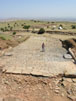
An area of stone pavement (Fig. 37),
partly robbed, extended towards the Audience Hall. A drain set into the
pavement along the rear façade took surface runoff away from the entrance
in a northerly direction. The portion of this drain that runs across the
front of the entrance was more neatly and regularly built than its northern
end (Fig. 38).
On the excavated north side, set into the paving beyond the second partition,
was another square column base with a circular recess for a wooden column
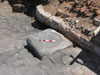
(Fig. 39).
The diameter of the recess was, at c. 0.80m, slightly less than in the
bases at the front of the entrance. Looters had, at some time in antiquity,
dug around this base and then beneath it, with the result that it was
discovered pitched into a robber pit. It is highly probable that before
the commencement of the extensive robbing in the entrance the top of this
base stood proud of the surface and was thus visible.
It is likely that the two columns at the rear of the entrance were set
a little beyond (i.e. to the west) of the back of the towers. Such an
arrangement would have formed a roofed porch that reflected the open porch
at the front of the entrance. The rear walls of both towers are very ruinous
and partially disturbed by robbing, with the result that their precise
position cannot be determined without considerable excavation.
The Towers
In plan, the towers are rectangular and each measure approximately 15.60m
by 13.00m. The position of the rear face has not been exactly ascertained,
precluding precise determination of their length. The corner of the South
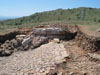
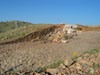
Tower was exposed after the collapse (Fig. 40)
was carefully recorded and removed. Little was done by the North Tower
apart from cutting back further the dangerously loose edge of the excavated
area (Fig. 41).
The preserved lower parts of the towers were solid and provided a platform
where the sloping ground rises a vertical distance of more than three
metres over the front half of the entrance. Doubtless they surround and
conceal outcrops of bedrock and the lower, preserved, walls are retaining
walls for the stone rubble fill. Of the internal arrangements and floors
nothing has been seen because of very extensive robber pits dug into the
core of both towers. From what is known of similar terracing in Structure
A (behind the glacis to the north and east of the entrance) and from test
trenches excavated at the north end of the city in 1996 and 98, it might
be expected that the foundations of internal walls were constructed within
the rubble fill of the terrace, but most if not all, will have been destroyed.
Turning now to the walling of the towers, although a better understanding
has been gained through revelation of the south tower there are outstanding
problems that restoration of architectural blocks may partially resolve
in 2006. What follows is, therefore, both preliminary and somewhat tentative.
It is reasonable to assume that all of the four exposed outer faces of
each tower were faced with cut granite to the same level. This level was
in fact one course, about 0.80m, above the top of the stone pavement at
the higher western end of the entrance. As the height of the top course
of cut granite facing stones increased down the sides, the number of courses
increased to four courses on the eastern wall of each tower.
In the passage, above these cut and tightly fitted granite blocks (described
in detail below) was a course of yellow sandstone above which was a course
of soft white (chalky) limestone. It is now thought that the sandstone
and limestone courses continued along the tower fronts. The courses were
interspersed with large horizontal timber beams at least 0.30m high. It
can be expected that these beams were squared to ensure structural stability.
The top of the sandstone course does appear to have been tied by swallow-tailed
wooden clamps which most probably fixed the floor joists. If this is correct
the course of white chalky limestone would have stood higher than the
internal floor. Some confirmation of this idea may be the evidence that
vertical timbers of wooden framing for the upper walling, infilled with
stones and some clay, began at the level of the sandstone. It must be
admitted however that the evidence for these ideas might also be interpreted
differently.
From the centre of the front façade across the passage back to, presumably,
the rear of the tower, the wall faces were composed of angular fieldstones.
In other words, cut facing stones were not used for those portions of
the passage wall that were hidden by the inner portion of the passageway
and parts of the wooden façades. This, incidentally, is further indication
that the small rooms within the inner portion of the passageway were part
of the original construction.
Additional questions that currently evade satisfactory answers relate
to the original height of the towers and the treatment of their corners.
Here the difficulties are compounded by the existence of numerous fallen
blocks of sandstone with engaged bolsters and bolster elements, and other
forms of architectural embellishment. The majority of these smashed blocks
are awaiting further study and restoration in 2006 after which, it is
anticipated, their number and architectural arrangement will become clearer.
At a more detailed level, it was observed that the granite blocks were
snugly fitted with seating for inserts to level courses between beams.
Behind each of the two column bases at the front, the granite stone making
up the first course running up the slope of the side walls were made of
very much smaller, but nevertheless neatly squared and tightly fitted
blocks (Fig. 42).
Jointing between adjacent granite blocks was by no means always vertical,
with triangular or even curved granite plugs being shaped to fit where
necessary. Such deviance from vertical jointing has not been seen in the
softer sandstone masonry, although large blocks could be L-shaped and
plugs were often used.
As to the upper walling, burnt debris filling the passage points to the
use of angular granite rubble and some mud as filling between timber elements.
Height is difficult to estimate. Because of the extent of the robber pits
in the passageway estimation of the height of the upper walling of the
towers is not straight forward. However, the fallen mass of infill from
the south tower would not be inconsistent with the concept that at the
front the height of the upper timber frame portion of the towers was equal
to the lower stone facing. There is no clear evidence as to the width
of the upper walling which, to judge from shapeless fused and vitrified
blocks, may have been no more than 0.80m. In the absence of other indications
it can be assumed that the towers were roofed (otherwise they might have
been solid to the top). It now seems highly probable that the fragments
of burnt clay with reed and timber impressions came from roofing of the
towers rather than as had been thought at one time, a passage roof.
Clamps
An important detail, not least for the chronology, is the use of wooden
swallow-tail clamps, the charred remains of one having been recovered
in the cutting itself. Small neatly carved clamp cuttings were recorded
on the two large, faced, granite blocks, that stood on the northeastern
corner of the South Tower and the adjacent block to the west. These smoothed
clamp cuttings were for mending granite blocks that had broken during
construction. In the sandstone, by contrast, there were numerous swallow-tailed
clamp cuttings. There were deeper, not particularly regular and rather
rough clamp cuttings, exhibiting considerable variation in size, in the
sandstone (but not apparently in the soft limestone). They appear to have
been cut with the same tools as were used for shaping and finishing the
sandstone and limestone blocks (but not the much harder granite), and
essentially these appear to be woodworking adzes and chisels. Clamps were
used to join adjacent blocks in wall faces and, at 45º angles, to brace
blocks on tower corners (Fig. 43).
In addition there were, as reported last year, clamp cuttings that perhaps
secured facing blocks to floor joists. It can be argued that the beams
were floor joists rather than timber lacing within the core of the tower
since in the latter case some evidence of charred timbers would have been
recovered.
Proposed Architectural Reconstruction
It behoves us to make some attempt at reconstructing this monumental entrance.
As he approached the entrance, the visitor would have seen a broad stone
paved entrance between two massive towers. At the top of a steep incline,
between the towers, stood a decorated wooden front façade containing broad
double doors at its centre. When both these doors and the similar double
doors through the rear façade were thrown open, the entrance to the Audience
Hall would have been visible. Walking up the worn and slippery granite
pavement towards the doors, the visitor would have passed a pair of wooden
columns on stone bases, carrying stone capitals or perhaps statuary, and
seen sculpture on large stone plinths either side of the doors. Reaching
the top of the incline would reveal the pavement continuing through the
entire passageway up to the Audience Hall. The front of the towers on
either side rose perhaps as much as a total of eight metres. While the
bottom half of their front wall was constructed of silver-grey granite,
yellow sandstone and white limestone, the top half probably comprised
a mud plastered timber framed structure. Somewhere, perhaps in rows along
the front, were sandstone bolsters with additional embellishments on the
corners. The façade, following rock-cut examples from the highlands, would
have had a triangular pediment crowned by an akreterion which might have
hidden from view a raised walkway between the towers. The rear façade
would have looked similar but here the freestanding columns (or columnar
bases) stood forward of the tower walls and the doors were flanked by
a pair aniconic stele with rectangular sunken offering places in front
of each. |
|